
Wildfire Risk Isn’t Binary: Lessons from Topanga Canyon
Rising wildfire exposure, shrinking insurance capacity, and the question of how homes in fire country remain insurable.

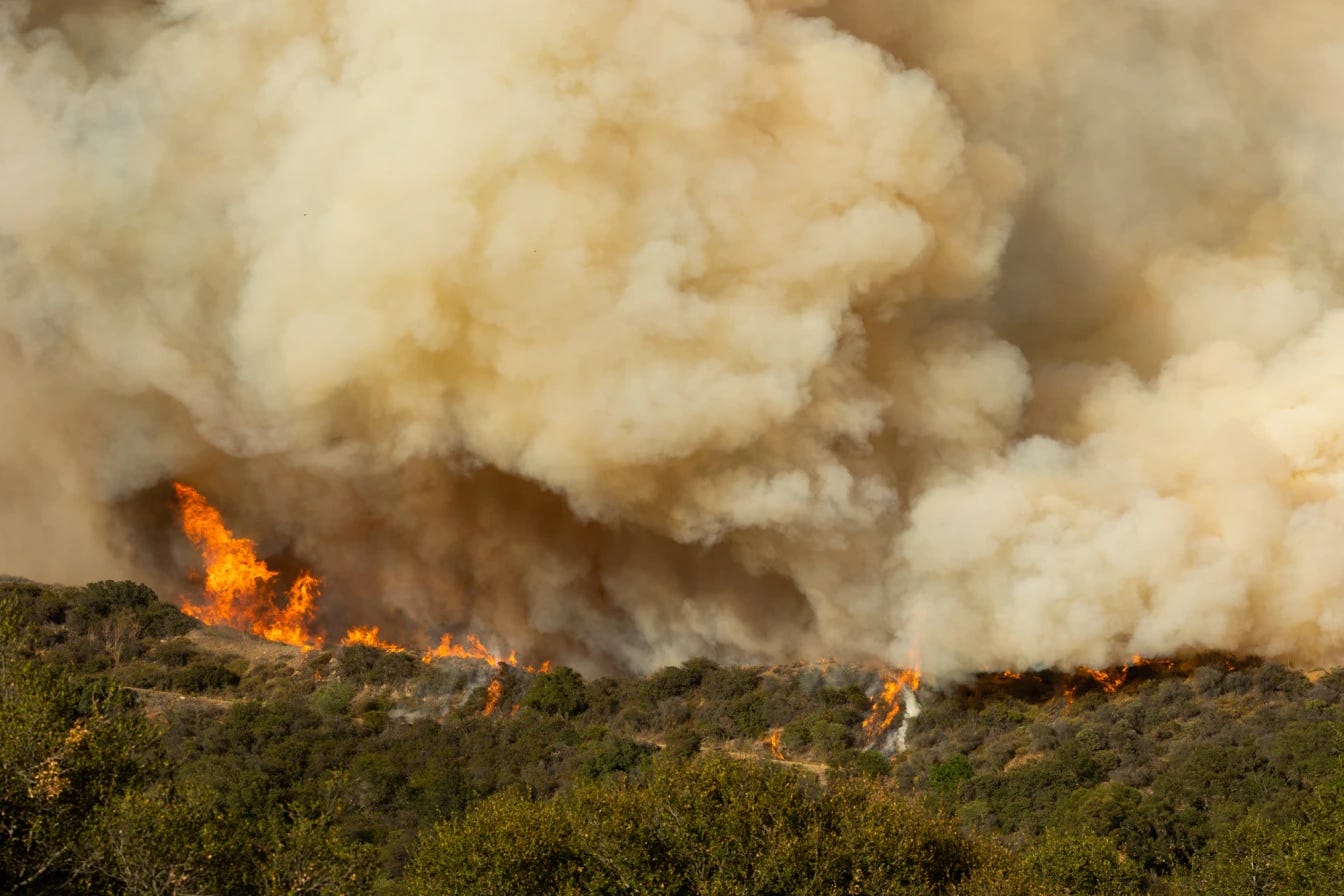
Photo Credit: Brian Feinzimer for LAist
Topanga Canyon is a rustic, unincorporated enclave in Southern California’s Santa Monica Mountains, situated between Malibu and Pacific Palisades. Narrow, winding roads cut through steep terrain, where homes range from ramshackle cabins to high-end, secluded estates. Some homes cluster along canyon roads; others sit tucked deep into private lots. Everywhere, the built environment and wilderness intertwine. Access in and out is limited.
Even with all its storied, hippie-era LA mythology, if you’re a fire-obsessed person like I am, what you notice first in photos of Topanga Canyon is the sheer amount of dense chaparral built up across those hillsides. That’s a lot of fuel.
Topanga Canyon is one of Southern California’s most exposed communities.
When the Santa Ana winds align, the canyon can act like a funnel, accelerating fire behavior and carrying embers far ahead of the flame front. Even before the Palisades Fire devastated parts of the canyon in 2025, fire behavior analysts had been warning for years about the unique vulnerability of Topanga Canyon, noting how quickly flames could move from inland valleys toward the coast through its natural corridors.
Residents of Topanga Canyon know the risks well. Evacuation alerts are a part of life. And as their “fire season” grows ever-longer, homeowners are increasingly being served insurance non-renewal notices. In 2023 alone, more than one in five homeowners in Topanga’s 90290 ZIP code received one.
The 85 Percent Promise
Over the past several years, traditional homeowners insurers have pulled back from many high-hazard areas across California. Communities like Topanga are feeling it. As carriers reassess wildfire exposure, homeowners have found themselves pushed onto the California FAIR Plan, the state’s insurer of last resort. Designed as a temporary safety net, the FAIR Plan carries hundreds of billions of dollars in exposure statewide. But coverage is more limited than a standard homeowners policy, with many residents purchasing supplemental policies to approximate comprehensive protection.
In response to market instability, California regulators introduced what’s known as the “85 percent promise.” It means that insurers looking to use forward-looking catastrophe models and reinsurance costs in pricing must write policies in designated wildfire-distressed ZIP codes at no less than 85 percent of their statewide market share. The goal is to tie pricing flexibility to participation in high-risk communities.
Recently, however, a New York Times investigation found that implementation was uneven: ZIP codes don’t always align cleanly with the state’s highest fire-hazard zones, which means the framework doesn’t guarantee that the most exposed canyon communities, or even current FAIR Plan policyholders, will be prioritized.
For homeowners in places like Topanga, that distinction matters.
What the Science Says About Risk in Places Like Topanga
Research analyzing nearly 47,000 structures across five major California wildfires found that the single strongest predictor of whether a building survived a wildfire was distance to nearest structure.
In dense communities, wildfire can become an urban conflagration. Once one building ignites, fire spreads from parcel to parcel through heat and embers.
In Topanga, spacing and terrain are fixed. The canyon can’t be redesigned.
But what CAN change is the structure itself. Studies show that hardening structures – ember-resistant vents, noncombustible roofs, dual-pane tempered windows, and clearing the first five feet around a home – dramatically improve survival odds, with additional defensible space improving outcomes even further.
That means even in the same canyon, two homes don’t carry the same risk.
The Missing Link is Underwriting Recognition
The insurance crisis in communities like Topanga is often framed as binary: high hazard equals no coverage. But that ignores differentiation.
Research shows that while proximity drives baseline exposure, hardening and defensible space materially reduce expected loss. A recent UC Berkeley–led study found that effective mitigation strategies can reduce wildfire destruction by up to 50%.
The 85 percent framework addresses availability at a market-share level. But it ignores variation between properties in the same ZIP code.
So while policy reform may expand availability, mitigation actually reduces severity.
The missing link is underwriting recognition – the ability to distinguish between unmanaged risk and demonstrably mitigated homes.
Why This Matters for Topanga and Beyond
Topanga Canyon is emblematic. Across California’s wildland–urban interface, homeowners are caught between rising hazard and shrinking insurance capacity.
I think the future of residential insurance in fire country will depend on three things working together:
Regulatory frameworks that encourage participation in distressed communities.
Clear, science-based mitigation efforts that measurably reduce loss.
Underwriting models capable of recognizing and rewarding properties that act on that science.
You can’t move the canyon, redirect the wind, or redesign an entire neighborhood. But you can harden structures, eliminate ignition risks in the first five feet, and document mitigation in ways that change how risk is evaluated.
In communities like Topanga, that distinction may determine whether meaningful coverage remains available at all. Helping homeowners navigate that reality (and ensuring mitigation work actually counts with insurers) is exactly the problem RockRose is built to solve.
Start with a free quote to understand your Residential coverage options – no cost or commitment required. We’d love to chat.
Follow along for future posts as I dive deeper into where the future of proactive protection is headed and how we can reimagine insurance for a new era of risk.
Andrew is correct. It is the structure makes the difference. Many Californians who have lost homes are turning to RSG 3-D’s award-winning Resilient Panel Building system. Never a victim of fire (or earthquake) over 30 years in 20 counties.